Once in a while there comes along an opera in an “updated” production that does not offend, but works. This Faust was one of those. Perhaps playing off of John Adams’s Dr. Atomic, producer Des McAnuff set the opera in the laboratory of Dr. Faust, a physicist with the Manhattan Project. The constant in every scene was a pair of industrial-grade steel balconies and railings and spiral staircase, one to the left and one to the right. In the center of the back wall was a huge opening, as tall as the Met stage permits, in back of which various images were projected. A small number of props were placed in the center of the stage for each scene.
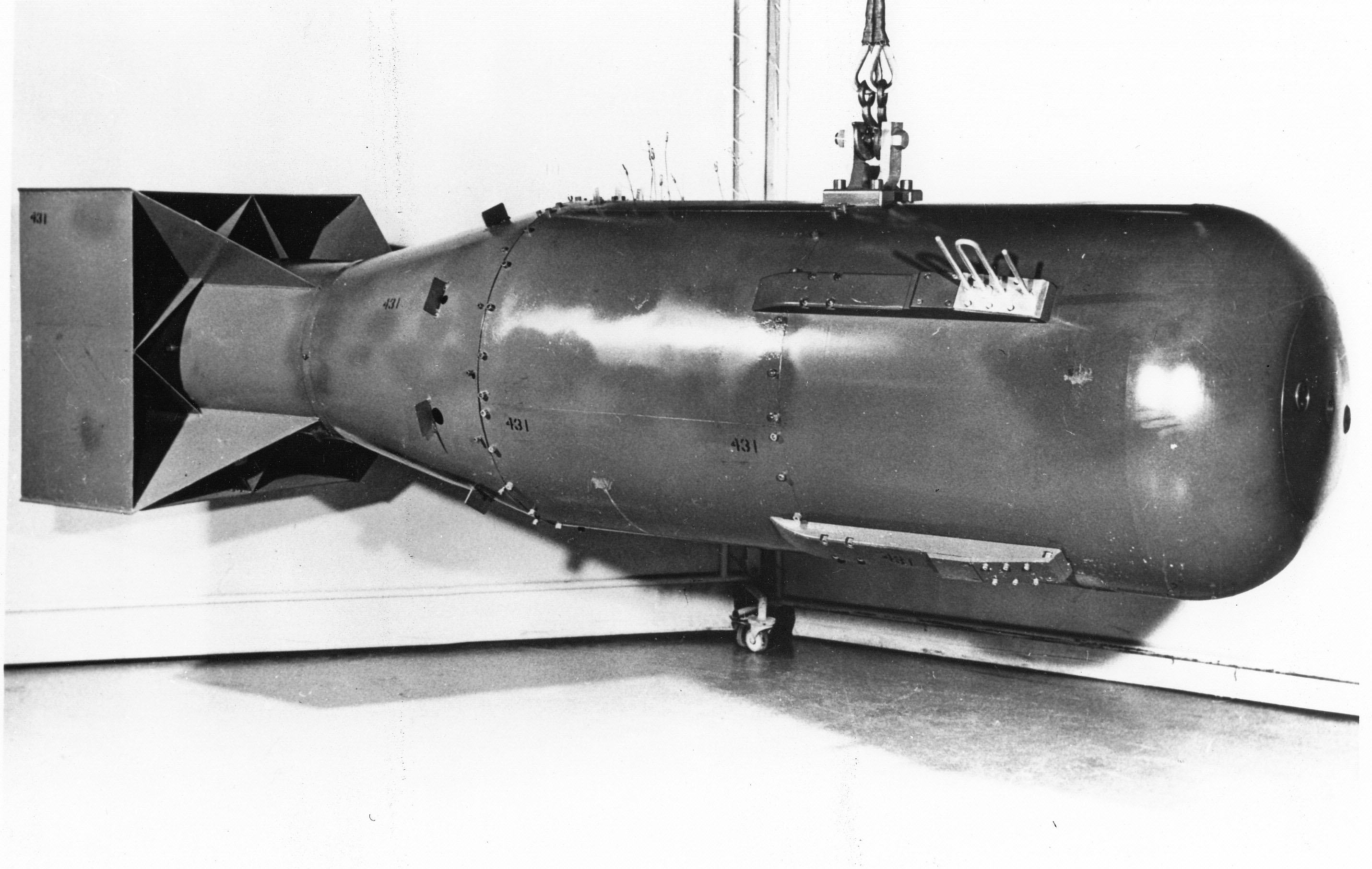
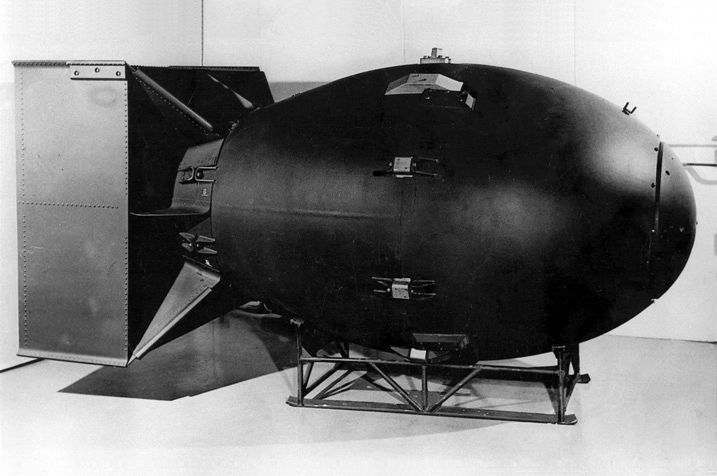
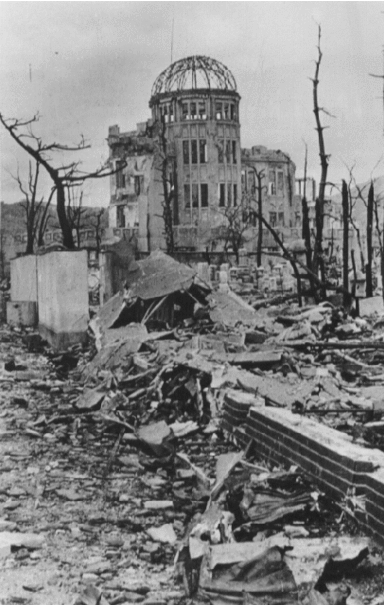
In Act 1, the props included (large) models of Little Boy and Fat Man suspended in the air, and one of the projected images was of the Atomic Bomb Dome. There were a number of industrial-grade tables in Dr. Faust’s laboratory, covered by sheer white cloths; when Mephistopheles arrived, the cloths were whisked/blown away. At one point we saw Marguerite as a lab assistant working with a complex piece of laboratory equipment that looked something like a lathe.
For Act 2 the laboratory tables with equipment were removed and the crowd brought in other tables for the tavern scene. Respecting the libretto, Valentin did brandish his sword at Mephistopheles. Instead of making a cross of the pieces of the broken sword, a staging device that I have previously seen used to great effect, Valentin threatened Mephistopheles with the medallion that Marguerite had given him, and a few members of the chorus constructed a large “cross” by hoisting one table on its short side, with another table above it, and a third table positioned horizontally in front of the second to form the crossbar.
In Act 3 there were just a couple of low benches; Siebel put his bouquet on one of them and Faust placed the jewel box beneath the other one. There was also a foot-powered Singer sewing machine at which Marguerite worked.
Act 4 was most notable for presenting a Marguerite about 9 months pregnant; at the end of the church scene, she disappeared briefly in the middle of the chorus and then emerged no longer pregnant but holding a small bundle, which she promptly stuffed into the laboratory’s wash basin (the same wash basin from which Siebel had gotten his holy water in Act 3).
Act 5 opened with a scene that, in my experience, is even more rarely presented than the Wolf’s Crag scene in Lucia di Lammermoor—the Walpurgis Night scene. A number of ghouls with ghastly makeup were seated on both sides of a long table which held a Little Boy with its top hatch removed and its “entrails” spilling out onto the table. In the final scene, Marguerite was locked in a 10x10 steel jail cell, which Faust opened with the key that Mephistopheles has provided. When the chorus sang “She is saved!” she ascended to heaven by walking up four flights of industrial-grade steel stairs at the back of the stage, while Mephistopheles and Faust sank down through a trap door. At the very end, Faust reappeared, dressed again as the old man that he was at the beginning, and drank the beaker of poison that he had poured near the beginning of Act 1, then collapsed on the floor—as though the events of the opera had been a dream.
Our cast:
Faust: Jonas Kaufmann
Méphistophélès: René Pape
Marguerite: Marina Poplavskaya
Valentin: Russell Braun
Siébel: Michèle Losier
Conductor: Yannick Nézet-Séguin
Production: Des McAnuff
René Pape, with his luscious bass voice, made a commanding Mephistopheles, and seemed to get the most applause at curtain call time. Jonas Kaufmann was a superb Faust; he included a diminuendo at the end of Act 2 that I missed but my neighbors marveled at. Marina Poplavskaya’s Marguerite seemed a bit tentative. Russell Braun’s (Valentin) death scene was masterful, but the music gave no break for applause. The orchestra under Yannick Nézet-Séguin performed magnificently. The encore performance is Wednesday, Jan. 11; attend if you can. It’s not an alpha, but at least a very solid beta.
Saturday, December 10, 2011

Saturday, December 3, 2011
Rodelinda, Metropolitan Opera HD Live, Dec. 3 2011
Rodelinda is the oldest opera yet presented in the Met HD series. Iphegenie in Tauride dates back to 1779, but Rodelinda, regina de’ Longobardi (to give it its full name) was premiered in 1725. Some of us noted resemblances between Rodelinda and The Messiah; the latter was composed in 1741 and first performed in 1742. Self-borrowings were not uncommon at that time.
The first act opened in a large, spare bedroom, with Rodelinda chained by one arm to her very simple bed. She was soon released by Grimoaldo, usurper of her husband’s throne. Thereafter the scenes shifted between a courtyard and a library. The most prominent feature of the courtyard was a large obelisk; to the right there was a small stable for four to six horses. The library was magnificent: two stories, with balcony, and with hundreds of large books behind glass doors. Even with Met HD close-up camera work, it was not apparent that the books had titles. My guess is that each book was actually a papier-mâché block painted with a large stripe for the title area and thinner stripes for the binding cords. Nevertheless it was very effective. For one scene the courtyard was raised out of sight so that we could see the prison in which Bertarido (the deposed king) was being incarcerated.
Our cast:
Rodelinda: Renée Fleming
Eduige: Stephanie Blythe
Bertarido: Andreas Scholl (countertenor)
Unulfo: Iestyn Davies (countertenor)
Grimoaldo: Joseph Kaiser
Garibaldo: Shenyang
Conductor: Harry Bicket
Production: Stephen Wadsworth
Renée Fleming sang well; I certainly liked her performance here better than her Lucrezia Borgia, recently seen at San Francisco Opera. But I preferred Stephanie Blythe’s singing, if not her acting—certain advantages accrue to a person of Fleming’s size rather than Blythe’s. Of the two countertenors, I much preferred the Unulfo of Iestyn Davies. (Interesting sidelight: in the intermission interview, both countertenors demonstrated their normal speaking voices; Andreas Scholl could pitch his speaking voice rather low. Neither had missed puberty.) Shenyang contributed a mellifluous bass voice in his relatively minor role.
The authenticity and detail of Stephen Wadsworth’s sets were entirely in keeping with the “authenticity” and detail of his sets for Der Ring des Nibelungen in Seattle, currently my gold standard for Ring productions. (Start making plans for the 2013 Seattle Ring!) The music was pleasant, though not particularly memorable or cathartic. A beta.
Friday, November 25, 2011
La Voix Humaine and Pagliacci, Opera San Jose, Nov. 22 2011
Two days later, back to San Jose to see the other cast perform this unusual double bill. The sets and action were the same as in the first cast. I was very much looking forward to seeing this cast because A Woman would be sung by Suzan Hanson, who had sung Tatiana in the company’s 1989 (?) production of Eugene Onegin and had turned in one of the most impressive performances I have seen on the operatic stage.
Our cast:
A woman: Suzan Hanson
Conductor: Andrew Whitfield
Director: Layna Chianakas
This evening, the acting wasn’t up to the standard set by Betany Coffland two days before. Hanson sang well enough, but didn’t convey the intensity of feeling that Coffland had. A bit better than a gamma.
Our cast for Pagliacci:
Tonio: Jason Detweiler
Canio: Travis Jones
Nedda: Jouvanca Jean-Baptiste
Beppe: Michael Dailey
Silvio: Krassen Karagizov
Conductor: Andrew Whitfield
Director: Cynthia Stokes
This performance failed to reach the relatively low bar set by the performance of two days prior. Travis Jones appeared to be out of his element as Canio. Again, no magic, no intensity. A gamma.
La Voix Humaine and Pagliacci, Opera San Jose, Nov. 20 2011
La Voix Humaine (“The Human Voice”) is a one-act, one-singer opera by Francis Poulenc in which the singer spends 45 minutes on the telephone breaking up with the man that she had lived with for five years. Pagliacci, a 70-minute, two-act opera by Ruggero Leoncavallo, is one of the highlights of the verismo style of Italian opera. Pagliacci is usually preceded in the operatic evening by Mascagni’s Cavalleria Rusticana, not by La Voix Humaine. Why not “Cav & Pag”? According to Larry Hancock, it simply costs too much to do Cav & Pag; opening with La Voix Humaine allows for a reasonable amount of music in one evening without breaking the bank.
No economy of set was obvious in La Voix Humaine. We saw a clever representation of an apartment in Paris: the side walls and most of the back wall were basic flat black, but windows had been artfully sketched in using narrow, flexible white tubes (oversized drinking straws?). In the center of the back wall was a large double window that looked out over the rooftops of Paris. The apartment was furnished with a sofa and an easy chair atop a circular rug. Along the right wall was a small table with a mirror; along the left wall was a small bar in a box whose sides were on hinges, along the lines of a side-by-side refrigerator but much smaller. And in the center there was a coffee table on which rested the telephone, which plays an important part in the opera.
Our cast:
A woman: Betany Coffland
Conductor: Andrew Whitfield
Director: Layna Chianakas
The opera was based on a play by the same name, written in 1930 by the French playwright (and man of many other talents) Jean Cocteau. His actors had complained of being “over-directed,” not given enough freedom to display their acting abilities, so he said “Here’s a telephone and one half of a telephone conversation. Act away!” And Betany Coffland did. We first heard anguished sobs from offstage, then she rushed in and busied herself for three or four minutes with the mirror and the bar before the orchestra played the first note of music. For the next 45 minutes, Coffland held up her end of the telephone conversation masterfully, at one point winding the telephone cord around her neck. At the end, after they have hung up, she went and stood in the window, apparently about ready to jump a la Tosca, but then the lights went out. It was an excellent display of acting, and she sang pretty well too. A solid beta.
After an intermission, Pagliacci. Most of the money for sets must have been spent on La Voix Humaine. We saw a concrete wall curving in from the left, about 6 feet high at the edge of the stage, dropping gradually to about 3 feet high in the center of the stage. In front of the concrete wall there was an elliptical concrete “stage,” about 2 feet high and 15 feet long. To the right, nothing. The players did have a small (very small) cart that they pushed down the ramp in back of the curving wall, and there were some boxes that some assistants carried around. After intermission (we got an intermission after “Vesti la giubba” and before the intermezzo), the curtain rose on the same set, except that a wall with a door and a window had been erected at the back of the “stage.”
Our cast:
Tonio: Evan Brummel
Canio: Alexander Boyer
Nedda: Jasmina Halimic
Beppe: Michael Dailey
Silvio: Krassen Karagizov
Conductor: Andrew Whitfield
Director: Cynthia Stokes
Pagliacci can be an exciting opera, especially in the final scene when the actions of the play resemble real-life events so closely that the play-within-a-play breaks down and the Canio character “actually” stabs his wife and her lover. This time, there was no magic. I was sufficiently not caught up in the action that I began to wonder, “Where in his clown suit has Canio hidden the knife that he will use?” and I located said knife in Tonio’s hand. Tonio is standing at the edge of the “stage” and hands the knife to Canio when he needs it. To the director’s credit, this is the same knife that Canio almost used on Nedda just before “Vesti la giubba” and that Tonio had picked up after Beppe had wrung it from him—after all, Tonio had threatened Nedda with “You will pay for this!” after she had rejected his advances. Competently performed, but that’s all. A gamma.
Tuesday, November 22, 2011
Satyagraha, Metropolitan Opera HD Live, Nov. 19 2011
According to a superb commentary in the New York Review of Books, Satyragraha is the middle opera in a trilogy about “saintly men”: Einstein (Einstein on the Beach), Gandhi (Satyagraha), and Akhenaten, the father of Tutankhamun, and the pharaoh who attempted to introduce monotheistic religion to Egypt (Akhnaten). I love the music of Akhnaten and so had high hopes for Satyragraha. These hopes were only partly realized.
The structure of the opera is highly unusual. The libretto is in Sanskrit. The libretto consists of passages from the Bhaghavad Gita. These passages are not words that the characters would utter if they came to life, but rather phrases of the holy text that are appropriate to the action taking place on stage. And according to the Met’s web site, “Satyagraha features minimal subtitles. ... Glass did not wish the text to be understood -- just to be heard -- and to allow the actions on stage to speak for themselves.” There were some subtitles, but they were few and far between, so for long stretches we listened to language that we did not understand, without the aid of translation. Theoretically, that made no difference. In practice, I wondered whether this opera might work as an oratorio, without staging.
Our cast:
Miss Schlesen: Rachelle Durkin
M. K. Gandhi: Richard Croft
Mr. Kallenbach: Kim Josephson
Parsi Rustomji: Alfred Walker
Conductor: Dante Anzolini
Production: Phelim McDermott
All three acts of the opera took place in front of a semicircular wall made of corrugated steel, with doors along the bottom that opened and closed, and a “picture window” in which a different figure sat or stood (silently) for each act: Leo Tolstoy, Rabindranath Tagore, and Martin Luther King Jr.
In Act 1, we saw the young Gandhi as he arrived in South Africa, dressed in a lawyer’s suit. Upstage, two gigantic “puppets” were formed before our eyes; one appeared to be made of tenuously connected bits of paper and the other from woven baskets. The puppets reenacted the battle between the Kuruvas and the Pandavas.
In Act 2 we saw a line of oddly-dressed men in prominent plaids and clashing colors getting their shoes shined by other men dressed as menials, while upstage several large puppets wandered to and fro. These puppets seemed to be constructed of a papier-mache-like substance and featured grotesque expressions. In the second scene, long rolls of printed newspaper were unrolled across the stage, then wadded together, and the very large wad was grasped by a woman who was hoisted (along with her wad) to the top of the corrugated steel backdrop. In the third scene, the chorus displayed and then burned their registration cards.
The music of Acts 1 and 2 was not as compelling as the music of Akhnaten, but it was rather interesting in its own right. Things sort of fell apart in Act 3. The second and larger part of Act 3 was a long monologue by Gandhi, in Sanskrit, without subtitles, while up in the “picture window” an actor mimed the gestures of Martin Luther King Jr. addressing a (presumably) large crowd. With essentially no action, and no understanding of the words, and no significant variation in the music, Act 3 went by as a big “Huh?”
The whole affair came off as a bit better than a gamma. I will attend the encore, in the hope that a second experience will make more of an impression on me—and also as some sort of preparation for San Francisco’s upcoming production of Nixon in China, another opera in which no one falls in love, no one dies, and there is no inter-character conflict.
Monday, November 7, 2011
Carmen, San Francisco Opera, Nov. 6 2011
An intense week of opera-going (Don Giovanni, Xerxes, Don Giovanni, Carmen rehearsal, Siegfried, an aborted attempt at Susannah, Carmen) came to a conclusion with San Francisco Opera’s opening performance of their current Carmen. It was the Jean-Pierre Ponnelle production that dates back to 1981, with a common feature of all four sets being a a brick wall mostly covered with pale yellow plaster, and a long arch high above. In Act 1 there was a small door to the space on the other side of the wall, and a wall fountain from which townspeople could fill their jugs. There were some graffiti on the wall, the only legible one being “Viva Escamillo!” Just before the cigarette girls took their smoke break, the wall underneath the arch slid to the left, and a large double door with “Fabrica de Tabaco” slid in from the right. In Act 2, the area under the arch was filled with a large wooden platform up high and a staircase down to stage level. In Act 3 (the smuggler’s hideout in the mountains) the wall and the arch were still there, but the spaces below and behind the arch were filled with rocky landscape. In Act 4, in front of the bull ring, there was a large double door through which the crowd entered the arena, and a jailhouse-like metal gate through which the picadors and chulos and bandilleras marched to their jobs.
Our cast:
Carmen: Kendall Gladen
Don José: Thiago Arancam
Micaëla: Sara Gartland
Escamillo: Paulo Szot
Frasquita: Susannah Biller
Mercédès: Cybele Gouverneur
Le Dancaïre: Timothy Mix
Le Remendado: Daniel Montenegro
Moralès: Trevor Scheunemann
Zuniga: Wayne Tigges
Lillas Pastia: Yusef Lambert
Conductor: Nicola Luisotti
Director: Jose Maria Condemi
Set Designer: Jean-Pierre Ponnelle
Kendall Gladen acted the part of Carmen magnificently. She’s tall, statuesque, moves well on stage, and her body language and facial expressions fit my notion of Carmen to a T. Her voice, however, did not carry as well as it did in the dress rehearsal. Thiago Arancam’s Don Jose sounded rather strained and forced. Paulo Szot’s Escamillo failed to generate any sparks. Sara Gartland sang an affecting Micaëla; her third-act aria keeps running through my mind. Wayne Tigges sounded more in his element as Zuniga than he did as Ariodates in last week’s Xerxes. Yusef Lambert, in the speaking part of Lillas Pastia, had the best projection of the cast.
In an interesting touch, Jose Maria Condemi staged the entr’acte to Act 3, having Don Jose give Carmen a ring (the one that she will give back to him in Act 4 by putting it on the tip of his knife) and put his hand on her belly; she reacted with a pantomime of swinging a baby back and forth in the cradle of her arms—and then laughed with gusto. At the very end, with Carmen dead on the ground, Don Jose put the ring back on her finger. It was only this final confrontation that generated much in the way of excitement; all the preceding was competent but short on magic. Somewhat shy of a beta.
Saturday, November 5, 2011
Susannah, San Francisco Parlor Opera, Nov. 5 2011
What is San Francisco Parlor Opera? We didn’t know, but when we discovered that they were performing Carlisle Floyd’s Susannah, my favorite post-Puccini 20th-century opera, we jumped at the chance to see it. SFPO, as its name implies, performs opera in private homes. As a result, tickets are quite limited. This performance was limited to 55 attendees, and took place in the Zellerbach Mansion, across the street from the Panhandle of Golden Gate Park. Or rather, the performance took place in the back yard of the Zellerbach Mansion, during the first good rain of the season. Yes, they put up tarps in an attempt to keep the patrons dry. No, it didn’t entirely work. With only 55 patrons, in a private home, I was not expecting a full orchestra; I expected a piano, and got a piano. I expected an electronic piano that would sound like a piano, but I got a very distorted electronic piano that no one could possibly confuse with a real piano. The performing space consisted primarily of the steps from the yard up to the first floor. The young voices in open air did not carry well to the back of the audience. In general, my expectations were not very high. For the most part, even low expectations were not met. We bailed after about 10 minutes. At least we had a nice dinner at Jannah Restaurant beforehand.
Subscribe to:
Posts (Atom)